
The Big “If” of Our Era
August 1971. In a televised address, Richard Nixon closed the “gold window.” The US dollar was no longer convertible into gold at $35 per ounce, and the world entered the age of fiat currencies. More than five decades later—after episodes of high inflation, quantitative easing, and repeated geopolitical shocks—the question has returned: could gold once again become the foundation of money?
This article answers without mythology and without nostalgia—using numbers, sources, and realistic scenarios.
An Old Dispute: From a “Barbarous Relic” to “Gold = Freedom”
John Maynard Keynes famously labeled the gold standard a “barbarous relic” in A Tract on Monetary Reform (1923/24), arguing that it forces economies into painful deflations and strips policymakers of flexibility during crises.
At the opposite end stands a young Alan Greenspan (later Chairman of the Federal Reserve). In his 1966 essay Gold and Economic Freedom, he argued that “gold and economic freedom are inseparable,” claiming that a gold standard restrains political discretion and protects purchasing power.
Between these poles stands Charles de Gaulle. In a landmark 1965 press conference, the French president called for a “return” to a system in which gold would serve as the ultimate arbiter of value. France began converting dollars into gold and physically repatriating it to Europe.
These three positions – Keynes, Greenspan, de Gaulle – still define the spectrum of arguments in today’s debate.
What Does a “Return” to Gold Actually Mean?
A “return” to gold can mean at least five very different models:
- Classical gold standard (19th century): Fixed convertibility of banknotes into a specific weight of gold; international settlement in gold.
- Gold–exchange standard (Bretton Woods, 1944–1971): Only the dollar is convertible into gold; other currencies are pegged to the dollar.
- Gold rules without physical convertibility: Central banks target a stable “reference” gold price without full convertibility (proposed, for example, by Robert Zoellick in 2010).
- Commodity basket: A broader standard (gold plus other commodities) used as a compass for purchasing power.
- Free banking on gold: Competitive private issuance of gold-backed banknotes without a central bank (historical examples include Scotland).
Each model entails very different transition costs, operational risks, and political consequences.
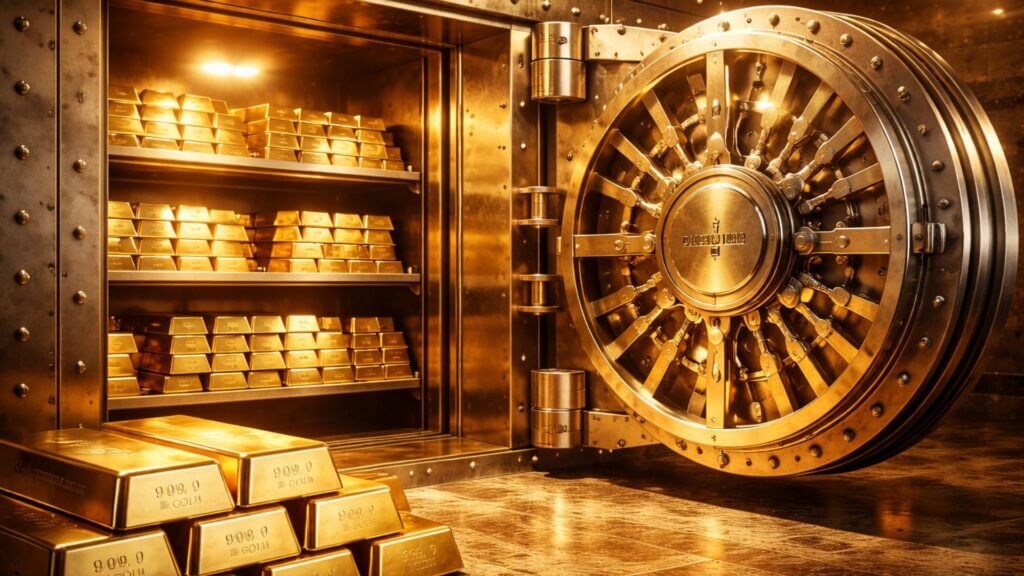
Image: Do you know where and how to buy gold? One of the most common options for buying gold is physical gold, such as coins, bars, or jewelry.


Do not buy a single gram of gold or silver until you have read this gold valuable information.
- Did you know that you can pay up to 59% more than the market price of gold?
- How can you significantly reduce the price of gold and silver?
- You can get up to + 1/3 more precious metals for your savings!
- Physical investment gold and silver of the highest quality. Good delivery.
BONUS! Extremely tax efficient: you pay absolutely no tax!
Enter your name and email address now to participate for free.

A Reality Check: What Would the Gold Price Have to Be?
If the United States were to fully back today’s M2 money supply with its official gold reserves (~8,133.5 tonnes), the arithmetic is straightforward.
In July 2026, US M2 stood at approximately $22.1 trillion. The US Treasury reports roughly 261.5 million ounces of gold. The result:
- M2 per ounce ≈ $84,600/oz (approximate).
- If only the monetary base were backed (≈ $5.74 trillion): ~$21,950/oz.
- If only physical currency in circulation were covered (≈ $2.4 trillion): ~$9,200/oz.
These figures are not “price targets,” but they illustrate the scale of adjustment required for full gold backing using existing reserves.
Do We Have “Enough” Gold Globally?
Total above-ground gold stocks are estimated at roughly 212,000–216,000 tonnes, with annual mine production adding about 3,000 tonnes.
That is small relative to global monetary aggregates—which is precisely why gold is an expensive standard: scarce, portable, and indestructible.

Lessons from the 20th Century
- FDR and the Gold Reserve Act (1934): Following Executive Order 6102 (1933), the Act transferred monetary gold ownership to the US Treasury and revalued gold from $20.67 to $35 per ounce. This replenished reserves and loosened the deflationary grip.
- Bretton Woods (1944–1971): The dollar was tied to gold, others to the dollar—creating exchange-rate stability, but also the Triffin dilemma: the issuer of the global reserve currency must supply liquidity to the world, undermining its own gold convertibility.
- The Nixon Shock (1971): The end of convertibility ushered in a decade of stagflation, until Paul Volcker crushed inflation with extremely high interest rates.
Supporters and critics of gold now largely agree on one point: in severe crises, every system gravitates toward gold – as a reserve, an anchor, or at least a reference.
Five Contemporary Scenarios (2026+)
-
A “gold compass” without convertibility
Gold serves as a reference point for inflation and currency risk. Flexible—but politically easy to ignore. -
Bretton Woods 2.0
Digital settlement, soft gold anchors, SDRs as an upgrade. In practice, SDRs remain political instruments rather than market anchors. -
Domestic convertibility, floating externally
A country could adopt gold-based rules domestically while maintaining floating exchange rates internationally. In reality, this would be a hybrid system, not Victorian England. -
Free banking on gold
Historical cases suggest market-based money can work under strict constraints, but the historical record is contested. -
“Gold + crypto” stratification
Digital money (CBDCs, stablecoins) operates alongside metallic reserves. The system becomes layered; metal is no longer required for real-time settlement, but may remain the ultimate reserve.

Image: Buying gold. What is a fair price? Many factors can affect the price of investment gold. Attention investors: the fair price of gold is primarily determined by the current economic and geopolitical environment.
Operational Questions Often Overlooked
- How much gold is “enough”? There is no universal number; it depends on whether the target is the monetary base, M2, or something else.
- Who bears the adjustment? Under fixed gold anchors, adjustment often occurs via deflation and wages rather than exchange rates—Keynes’s core critique.
- Geopolitics: Gold is physical and geographically located. Access to vaults is a legal and political issue.
- Audits and trust: The 21st century demands bar lists, not just statistics.
- Costs: Modern estimates suggest a technical transition is feasible at relatively low GDP cost—but “technically feasible” does not mean politically feasible.
PURCHASE OF GOLD. Free information. You can get up to 1/3 more precious metals!
- How can you buy gold and silver for investment?
- Much cheaper.
- We discover how you can reduce seller commissions.
- Highest quality. 999/1000. Good delivery.
Information worth its weight in gold. Completely free
It is not worth buying a single gram until you have this information.
Enter your name and email address now to participate for free.

Anecdotes and Figures That Illuminate the Dilemma
- Winston Churchill (1925): Returning sterling to its prewar parity was symbolically grand and economically painful—exactly as Keynes predicted.
- The Reagan Gold Commission (1981–82): Congress debated everything from full convertibility to gold clauses; most members opposed a return, but the report became canonical.
- Contemporary debates (2010–2026): Zoellick’s gold reference proposal, Judy Shelton’s controversial views, and BIS/ECB arguments that stability today depends more on rules than on metal.
What Would a “Gold World” Mean for You, Businesses, and the State?
- Households: Better long-term purchasing power stability, but harsher wage and price adjustments in recessions.
- Businesses: Less exchange-rate noise, more discipline—alongside tighter credit conditions.
- The state: Less scope for emergency money creation; fiscal discipline becomes a requirement, not a recommendation.
- Global trade: Less FX volatility, but greater competition for physical reserves. Location matters more than ever.
A Sober Conclusion
Yes – gold could again play a central role, but not as a carbon copy of 1910. A hybrid system or gold as a transparent reference compass is far more plausible. Digital infrastructure already enables real-time settlement; gold can serve as the reserve core and a signal, not necessarily as everyday currency.
For investors, the lesson is simple: if central banks quietly accumulate gold and policymakers increasingly cite it as an “anchor,” then gold is no relic in the collective imagination. It is an alternative constitution of money—scarce, heavy, and historically persistent.
Final Thought
If gold is called a “relic,” it is a relic of power—the ability to anchor trust outside politics and across time. There will be no return to the past, but we may yet see a gold compass: a disciplining signal backed by transparency, real-time settlement, and the institutional rigor demanded by the 21st century.
FAQ
John Maynard Keynes used the term “barbarous relic” to describe the gold standard as overly rigid and costly for domestic economies. He argued that it forces painful internal adjustments—especially deflation and wage cuts—and limits policymakers’ ability to respond to crises. The phrase originates from A Tract on Monetary Reform (1923/24).
Officially, the United States hold approximately 8,133.5 tonnes of gold, according to the United States Department of the Treasury.
The main storage locations are Fort Knox, West Point, and Denver, totaling roughly 261.5 million troy ounces.
Using official gold reserves of 8,133.5 tonnes:
- To fully back M2 (July 2026: ~$22.1 trillion): approximately $84,600 per ounce
- To back only the monetary base (~$5.74 trillion): approximately $21,950 per ounce
- To back physical cash in circulation (~$2.4 trillion): approximately $9,200 per ounce
These are illustrative estimates, based on data from Federal Reserve Economic Data and the US Treasury, not price targets.
Yes. In 2010, Robert Zoellick, former President of the World Bank, proposed that gold could serve as a reference point in a new international monetary framework—not as a fully convertible standard, but as an anchor for credibility and inflation expectations. The proposal was discussed in the Financial Times.
According to academic research (including work by Cutsinger and White), a return to gold-based monetary rules is technically feasible, with relatively low implementation costs as a share of GDP. However, it is considered politically extremely challenging, due to distributional effects and the loss of discretionary policy tools.
The Bank for International Settlements and the European Central Bank argue that the modern monetary system is layered (two-tier) and operates primarily through digital settlement. In this view, monetary stability can be achieved through rules, supervision, and institutional credibility, rather than through physical metal convertibility.