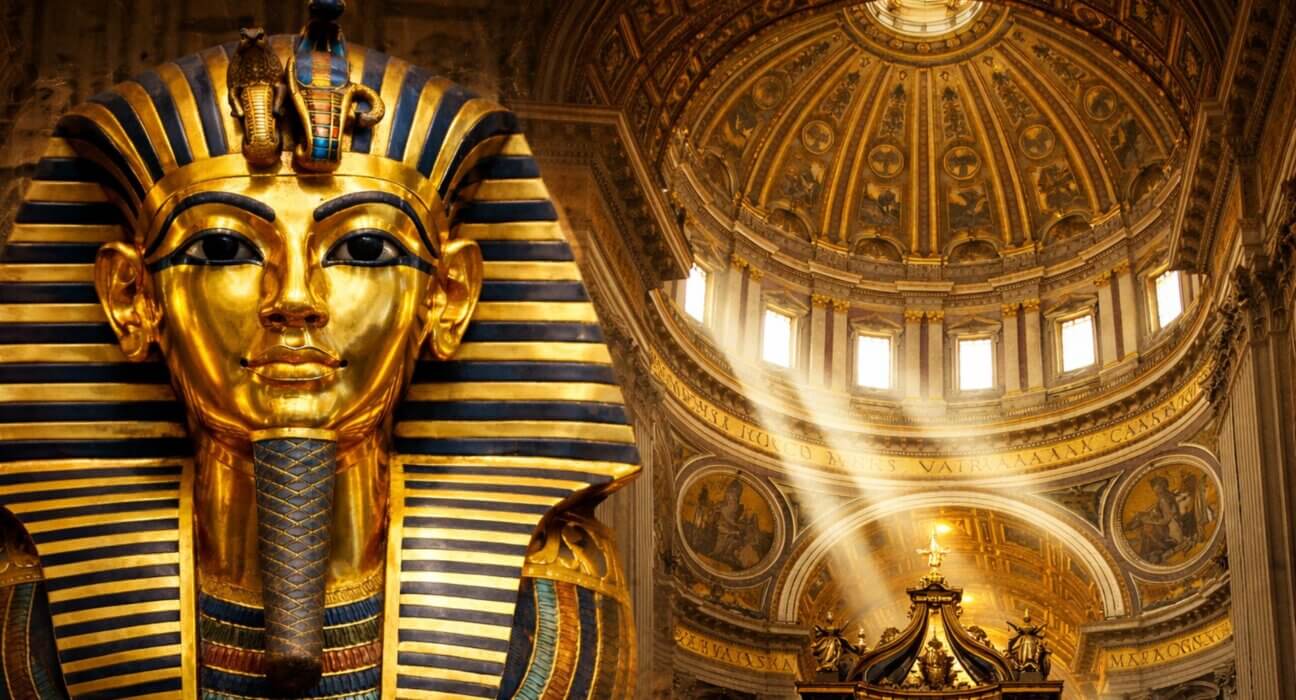
Introduction: The Metal That Smelled of Eternity
When you step into an ancient temple or cathedral, something familiar strikes you: light reflecting off gold. Whether you are in the tomb of a pharaoh, in a Buddhist pagoda, or beneath the dome of St. Peter’s Basilica — gold accompanies you.
It is no coincidence that gold is most often associated with gods. It is rare, eternally radiant, and never rusts. In the eyes of civilizations, gold became the substance that connects earth and heaven.
Egypt: Gold as the Flesh of the Gods
- In 1922, when Howard Carter opened Tutankhamun’s tomb, the world stood still. The mask of the young pharaoh, made from 11 kilograms of pure gold, shone like the sun. It was not decoration — it was a statement that the pharaoh was of divine descent.
- The Egyptians called gold “the flesh of the gods.” The sun god Ra was believed to shine in gold, which is why his images were always covered in it.
- As early as the 3rd millennium BCE, the Egyptians had gold mines in Nubia. Records from that time mention the “land of gold,” where slaves worked.
- The oldest known piece of gold jewelry — a necklace from a royal tomb in Varna (present-day Bulgaria) — is more than 6,000 years old.
- And one more remarkable detail: around 2600 BCE, the Egyptians learned to stretch gold into thin threads, barely 0.002 mm thick. These threads were used to embroider priestly garments.
Biblical Gold: Solomon and the Three Kings
When King Solomon built the Temple in Jerusalem (10th century BCE), reports stated that he used so much gold that “silver was considered of no value.” His palace alone featured 200 golden shields.
And when the three wise men from the East brought gifts to Jesus, the first gift was gold. This was not merely an offering of wealth. Gold signified recognition that the newborn was the “King of Kings.”
To this day, gold holds a special role in Christianity: Eucharistic chalices must be gilded because they touch the blood of Christ — a rule established by a Roman pope as early as the 9th century.


Do not buy a single gram of gold or silver until you have read this gold valuable information.
- Did you know that you can pay up to 59% more than the market price of gold?
- How can you significantly reduce the price of gold and silver?
- You can get up to + 1/3 more precious metals for your savings!
- Physical investment gold and silver of the highest quality. Good delivery.
BONUS! Extremely tax efficient: you pay absolutely no tax!
Enter your name and email address now to participate for free.

Byzantium: Hagia Sophia as the Sun on Earth
When Hagia Sophia in Constantinople was consecrated in 537, worshippers stood in silence. The 55-meter-high dome was covered with mosaics made of golden tiles. Each tile was the size of a fingernail — more than 30 million pieces in total — crafted from gold dust mixed with glass.
-
The chronicler Procopius wrote:
“When you enter, it seems you are not on earth but in heaven, for the gold reflects the divine light.”
For the Byzantines, gold was not merely wealth — it was proof that their empire was ordained by God.
Islam: The Gold Dinar and the Ban on Gold for Men
- When Caliph Abd al-Malik issued the first Islamic gold dinar in 696, it became one of the most powerful currencies in the world. It circulated from Spain to India for more than 500 years.
- Today, surviving dinars are worth tens of thousands of euros, as they symbolize the golden age of Islam.
- Islam also introduced a particular rule: men were forbidden to wear gold, while women were permitted to do so. The reasoning was that men should not become vain, whereas women could preserve gold as family heritage.
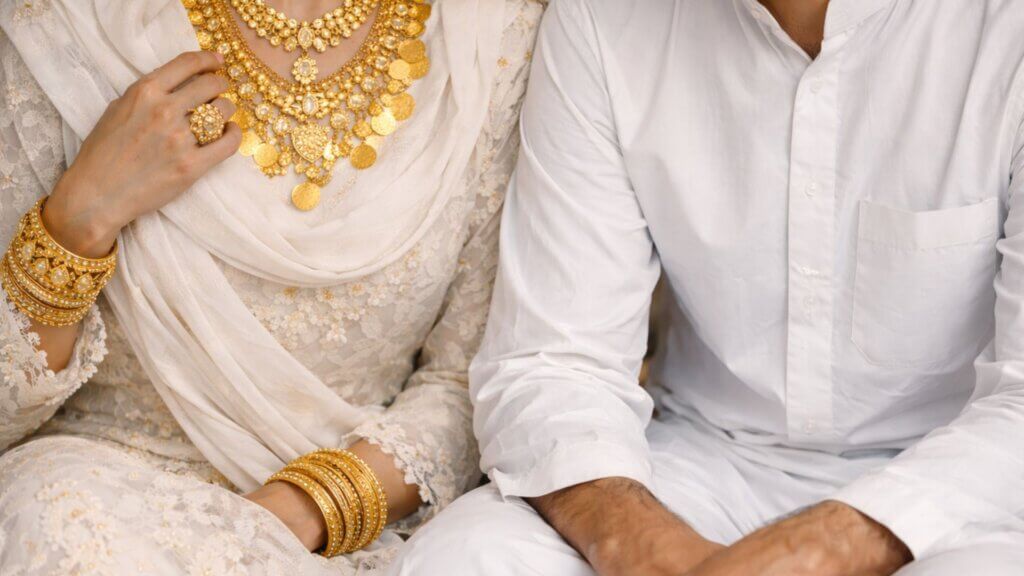
Image: While women preserved gold as family heritage, Islamic teaching encouraged men to refrain from wearing it to avoid vanity.
Buddhism: Golden Temples Reflecting the Sun
In Kyoto, Japan, stands Kinkaku-ji, the “Golden Pavilion.” Its upper floors are entirely covered in gold leaf. When the sun shines, the temple reflects in the lake as if floating in the heavens.
Even more impressive is the Shwedagon Pagoda in Myanmar. Its dome is covered with 60 tons of gold and adorned with more than 5,000 diamonds. Many believe it is the closest point where earth touches the sky.
The Vatican: Gold as Power on Earth
From the 16th century onward, Vatican churches were built with the idea that they must resemble “heaven on earth.”
The dome of St. Peter’s Basilica, designed by Michelangelo, is decorated with thousands of golden stars on a blue background. Inside, so much gilding is used that experts estimate more than 30 tons of gold are present in the Vatican.
-
In the 17th century, Pope Urban VIII declared:
“If gold disappears from churches, the light of God on earth will disappear with it.”
Today, the Vatican is considered one of the largest “invisible” gold treasuries in the world. Although it does not officially disclose figures, estimates suggest that the Vatican holds more gold per capita than any country in the world.
The Aztecs and the Incas: The Sweat of the Sun
- When the Spanish arrived in Tenochtitlan, the Aztec capital, in 1519, they were astonished. Palaces had walls covered with gold plates.
- The Aztecs called gold “teocuitlatl” — the excrement of the gods. For them, gold had no monetary value; it was a sacred substance.
- The Incas in South America believed that gold was the “sweat of the sun.” Their temple Coricancha in Cusco was entirely lined with gold — walls, altars, even gardens where plants and animals made of gold adorned the courtyard.
- When the Spanish saw this wealth, they melted it down and shipped it to Europe. The irony: for the Aztecs and Incas, gold was not money; for Europeans, it triggered inflation, flooding the Spanish market and lowering the value of silver and gold.
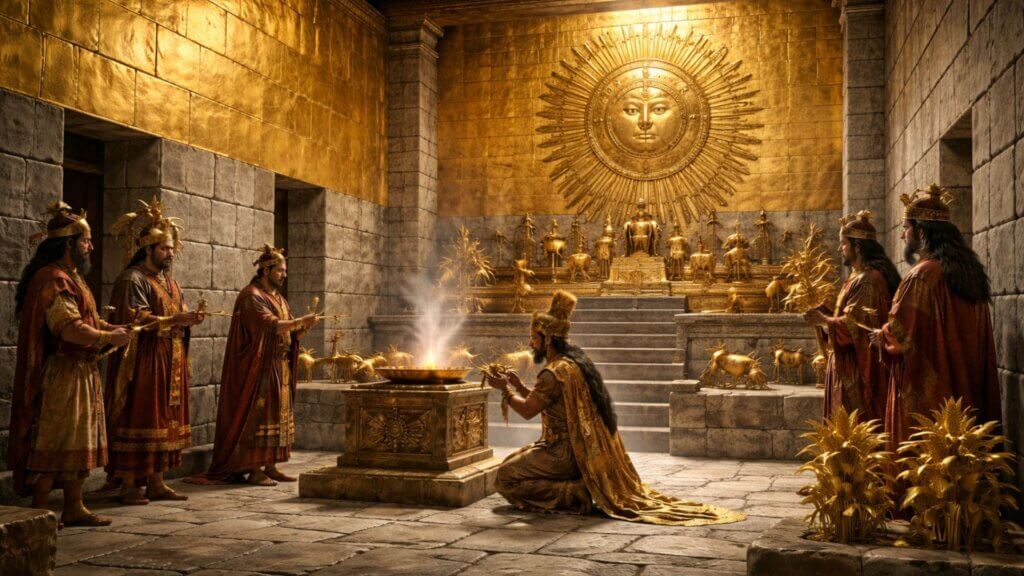
Image: The Inca Temple of the Sun (Coricancha) in Cusco, where gold symbolized divine power and was revered as the “sweat of the sun.”
Modern Culture: From Klimt to Hollywood
When Gustav Klimt created his masterpiece The Kiss between 1907 and 1908, he used hundreds of sheets of gold leaf. His “Golden Phase” proved that gold is not merely a relic, but also a medium of modern art.
In Hollywood, the greatest awards are clothed in gold: the Oscar statuettes are plated with 24-karat gold. The Golden Globes and major music and film awards — all use gold as a symbol of success.
-
Salvador Dalí once said:
“Gold is not just a metal — it is the color of eternity.”
Royal Families and Gold Today
The British royal family still preserves golden crowns, jewelry, and scepters. St. Edward’s Crown, used at coronations, contains nearly 2.5 kilograms of gold.
The Danish and Swedish royal treasuries hold similar collections — symbols of power reaching back centuries.
-
An interesting fact:
Many royal families today still maintain gold as a reserve. Although their wealth includes real estate and investments, gold remains the portion passed down from generation to generation.
PURCHASE OF GOLD. Free information. You can get up to 1/3 more precious metals!
- How can you buy gold and silver for investment?
- Much cheaper.
- We discover how you can reduce seller commissions.
- Highest quality. 999/1000. Good delivery.
Information worth its weight in gold. Completely free
It is not worth buying a single gram until you have this information.
Enter your name and email address now to participate for free.

Conclusion: Why Gold?
Why not silver, copper, or iron?
- The answer is simple: gold does not oxidize. Gold always shines. It is rare and difficult to obtain. That is why it became a universal symbol of eternity, power, and the divine.
- From Egyptian priests to popes, from Buddhist monks to Hollywood directors — all have desired the same thing: for gold to shine as a symbol of eternity.
FAQ
They believed it was connected to the sun god Ra.
11 kilograms.
It is estimated that more than 30 tons are used for domes, altars, and decorations.
Shwedagon in Myanmar – 60 tons of gold.
St. Edward’s Crown in Great Britain contains 2.5 kg of gold, and royal treasuries across Europe hold many additional tens of tons.