
New York, November 18, 2006. On the floor of the New York Stock Exchange, a new ticker lights up: SPDR Gold Shares (GLD).
For the first time in history, the average investor can buy a fraction of a physical ounce of gold as easily as a stock.
For many, it was just another ETF.
For gold, it was a tectonic shift — from vaults and mints to clicks, baskets, authorized participants, and exchange trading.
The Backstory: The First Gold ETF Wasn’t American
Many believe GLD was the first. In reality, the pioneer appeared on the Australian Securities Exchange: Gold Bullion Securities (GOLD).
The idea quickly spread:
- easier access to gold
- standardized ownership
- no need for personal storage
The World Gold Council supported this evolution by reducing friction for investors worldwide.
GLD: How the “Gold Machine” Works
SPDR Gold Shares (GLD) launched in 2006.
- Each creation unit = 100,000 shares
- Originally backed by 10,000 ounces of gold
- Each share ≈ 1/10 oz of gold (slowly declining due to fees)
- Gold is stored as:
- LBMA Good Delivery bars (~400 oz)
- primarily in London vaults (HSBC, later JPMorgan)
👉 Key insight:
GLD is not just paper — it is backed by physical gold.
- However:
- retail investors cannot withdraw gold
- only authorized participants (APs) can redeem physical metal
IAU and GLDM: Cost Competition
- After GLD, BlackRock introduced:
- iShares Gold Trust (IAU) (lower cost)
- Later, in 2026:
- SPDR Gold MiniShares (GLDM) launched as a low-cost alternative
- Rule of thumb:
- GLD → highest liquidity, highest cost
- IAU → balanced option
- GLDM → lowest cost, long-term holding


Do not buy a single gram of gold or silver until you have read this gold valuable information.
- Did you know that you can pay up to 59% more than the market price of gold?
- How can you significantly reduce the price of gold and silver?
- You can get up to + 1/3 more precious metals for your savings!
- Physical investment gold and silver of the highest quality. Good delivery.
BONUS! Extremely tax efficient: you pay absolutely no tax!
Enter your name and email address now to participate for free.

Creation & Redemption: The Price Alignment Engine
- When demand rises:
- authorized participants deliver gold → receive ETF shares
- When demand falls:
- authorized participants redeem shares → withdraw gold
- 👉 This mechanism ensures:
- ETF price stays closely aligned with the spot gold price.
Gold Flows That Shaped the Market
- 2006–2011: Golden Wave
- Massive inflows → gold becomes mainstream → price surge
- 2013: Taper Tantrum
- ETF outflows → sharp price decline
- 2020: Pandemic Surge
- Record inflows driven by global uncertainty
- 2022–2026: Divergence
- ETF outflows despite rising gold prices, driven by central banks and private buyers
- 👉 Lesson:
- ETFs reflect capital market sentiment — not the full picture of gold demand.
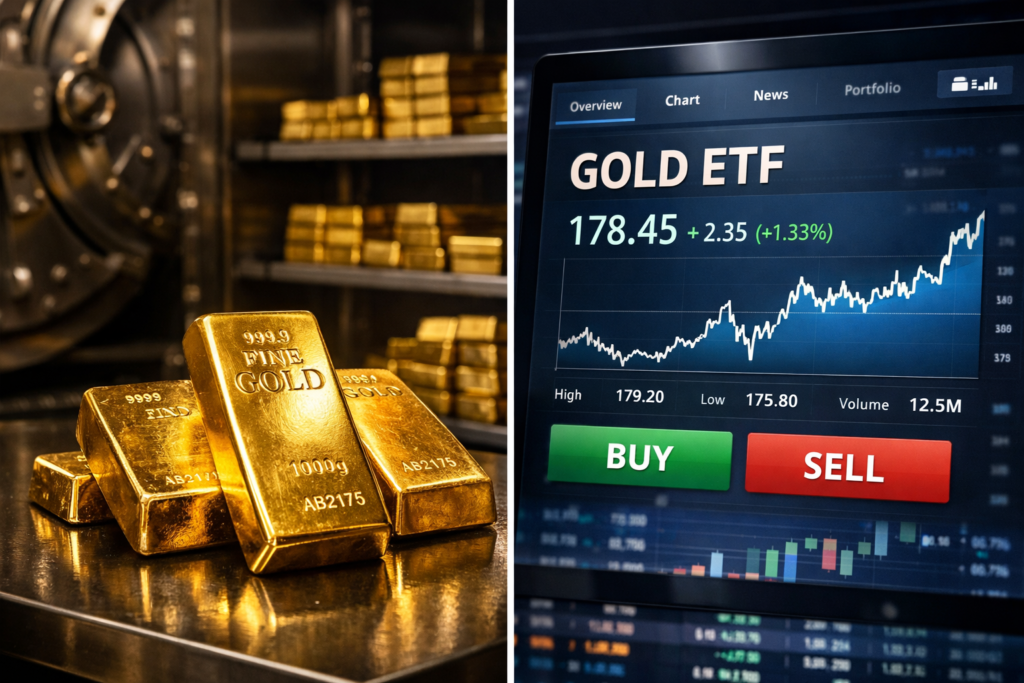
Image: Crises like COVID-19 often lead to market panic and monetary expansion, strengthening gold’s role as a hedge against inflation.
How ETFs Changed Investor Behavior
- Wall Street (2006):
- Gold becomes a standard portfolio allocation
- Zurich (2009):
- Rapid portfolio rebalancing during financial stress
- Ljubljana (2020):
- Monthly investing via GLDM combined with physical gold coins
Advantages of Gold ETFs
- Pros:
- Easy access and high liquidity
- Lower costs compared to storage and insurance
- Accurate tracking of gold prices
- Cons:
- No physical delivery for retail investors
- Custodial/operational risk (low, but real)
- Different tax treatment compared to physical gold
Europe: ETC vs ETF
In Europe, many gold products are structured as ETCs (exchange-traded commodities) backed by physical gold.
- Important factors:
- custody structure
- LBMA standards compliance
- delivery options (often with high minimums)
👉 Always read the prospectus carefully.
How ETFs Affect Gold Prices
ETFs do not produce gold — they connect investor capital with physical demand.
- Inflows → gold purchases → upward price pressure
- Outflows → gold sales → downward price pressure
Classic examples:
- 2013 → price decline
- 2020 → price increase
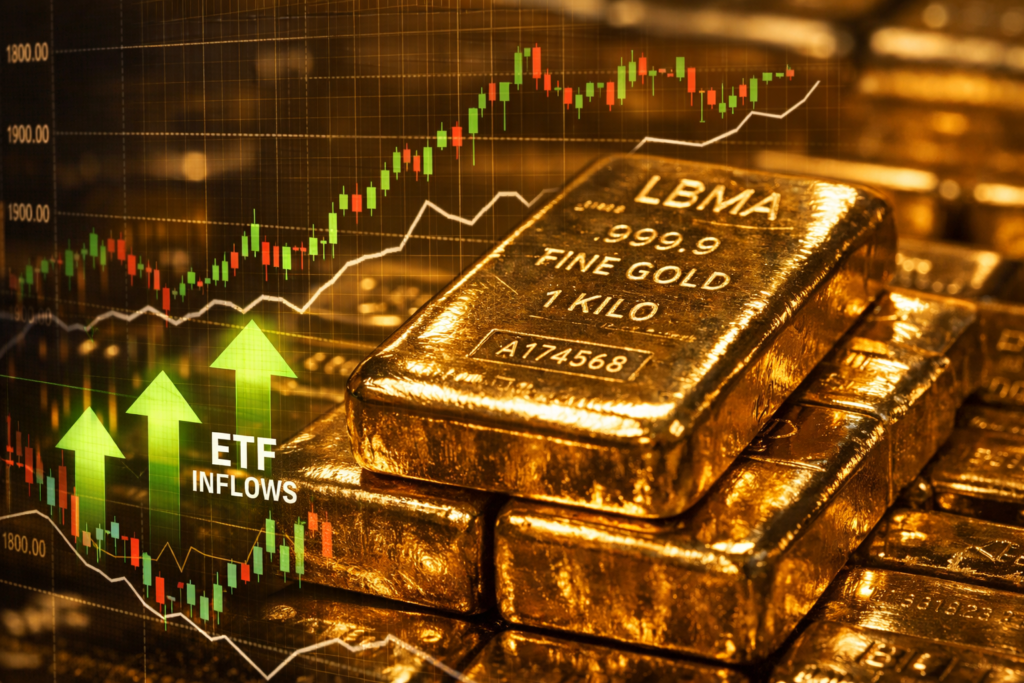
Image: Unlike paper money, physical gold provides tangible security and serves as a trusted hedge against inflation and economic uncertainty.
Transparency After Market Reforms
The old phone-based gold fixing system ended.
In 2026, the ICE Benchmark Administration manages the LBMA Gold Price through a regulated electronic system.
- Key improvements:
- enhanced transparency
- bar traceability
- stronger regulatory oversight
👉 These reforms significantly increased trust in gold ETFs.
PURCHASE OF GOLD. Free information. You can get up to 1/3 more precious metals!
- How can you buy gold and silver for investment?
- Much cheaper.
- We discover how you can reduce seller commissions.
- Highest quality. 999/1000. Good delivery.
Information worth its weight in gold. Completely free
It is not worth buying a single gram until you have this information.
Enter your name and email address now to participate for free.

ETFs vs Physical Gold
- Need liquidity and flexibility → GLD / IAU
- Long-term, cost-efficient holding → GLDM
- Wealth protection outside the financial system → physical gold
- Want delivery options → specialized ETCs
When to Use ETFs vs Physical Gold
- Entrepreneur hedging portfolio volatility → ETF
- Family wealth preservation → physical gold + ETF combination
- Active trading → ETF (tight spreads, high liquidity)
Common Misconceptions
“ETFs don’t hold real gold.”
Major ETFs are backed by LBMA Good Delivery bars with full transparency and audits.
“ETFs are always better than physical gold.”
ETFs are better for liquidity, while physical gold offers stronger protection in crisis scenarios.
“ETFs artificially inflate gold prices.”
ETFs are simply a channel — they reflect demand rather than create it.
Bottom line
Gold ETFs didn’t replace physical gold — they transformed access to it.
They turned gold from a vault-bound asset into a liquid, global financial instrument accessible to everyone.
FAQ
GLD launched on November 18, 2006. The gold consists of LBMA Good Delivery bars stored mainly in HSBC vaults in London.
No. Only authorized participants can redeem large baskets (100,000 shares). Retail investors sell shares for cash.
GLDM (~0.10%) is the cheapest. IAU (~0.25%) is mid-range, while GLD (~0.40%) offers the highest liquidity.
Yes. Inflows and outflows directly lead to buying or selling physical gold in vaults.
Gold Bullion Securities (GOLD) on the Australian Securities Exchange was the first, before GLD.
No. It is now an electronic auction managed by ICE Benchmark Administration.