
If reserve managers spoke like Reddit investors, their motto over the past three years would be simple: buy gold—and don’t make too much noise about it. Since 2022, central banks have purchased more than 1,000 tonnes of gold per year for three consecutive years—an all-time high in modern statistics. The records are confirmed by the World Gold Council (WGC) and Reuters: a record year in 2022, again above 1,000 tonnes in 2023, and an officially revised 1,086 tonnes in 2024. Entering 2026, analysts continue to expect around ~1,000 tonnes again this year.
Why “quietly”? Because central banks want to minimize price impact, comply with disclosure protocols, increasingly factor in geopolitical risk—and because the infrastructure of the London OTC market and the custody services of the Bank of England (BoE) make this possible.
What follows: who is buying, how they buy, where they store gold, what changed after 2022—and what it all means for investors and taxpayers.
The Big Picture: Central Banks as an “Anchor” of Gold Demand
- A three-year “gold wave.”
2022 set a record; 2023 marked a second consecutive year above 1,000 tonnes; and 2024 again exceeded 1,000 tonnes, officially revised to 1,086 tonnes by the WGC (revision published in spring 2025).
- Who bought.
Regular buyers were primarily in the East and in emerging markets: China (PBOC), Poland (NBP), India (RBI), with intermittent buying by Turkey (CBRT), Singapore (MAS), and others. Poland was the single largest buyer in 2024 (≈90 tonnes).
- Expectations for 2026.
In the WGC 2026 survey, a record 95% of reserve managers expect further net gold purchases over the next 12 months, while simultaneously anticipating a lower share of the U.S. dollar in reserves over the next five years. The most popular custody location remains the Bank of England.
Why They Buy: The Geopolitical and Financial “Cold Start” After 2022
- The risk of frozen foreign-exchange reserves
After February 2022, the U.S., EU, and partners froze roughly USD 300 billion of Russian sovereign reserves (a large portion held via Euroclear in Belgium). That event triggered a red alert in reserve-management circles: what is truly a “safe” asset? The EU continues to debate how to use the income generated by these frozen assets, keeping legal risks in the headlines. A parallel case is Afghanistan, where a large share of reserves was blocked or redirected into a trust structure.
Implication: Gold—especially when owned outright and physically controlled by the state—is less exposed to a political “OFF switch” than deposits in foreign bonds or foreign clearing systems.
- Diversification away from the dollar
The WGC’s 2026 survey shows that central banks expect a lower medium-term share of USD assets and a higher allocation to gold. Drivers include trade tensions, tariff risks, sanctions policy, and the broader “weaponization of finance.”
- Inflation, rates, and bond volatility
From 2022 to 2024, real yields were volatile and bond portfolios suffered. In that fog, gold functioned as a neutral hedge—a conclusion supported by professional reviews and WGC data.

Image: Do you know where and how to buy gold? One of the most common options for buying gold is physical gold, such as coins, bars, or jewelry.


Do not buy a single gram of gold or silver until you have read this gold valuable information.
- Did you know that you can pay up to 59% more than the market price of gold?
- How can you significantly reduce the price of gold and silver?
- You can get up to + 1/3 more precious metals for your savings!
- Physical investment gold and silver of the highest quality. Good delivery.
BONUS! Extremely tax efficient: you pay absolutely no tax!
Enter your name and email address now to participate for free.

How Central Banks Buy “Quietly”
-
OTC London (“loco London”).
Most transactions take place over the over-the-counter market, working with bullion banks and refineries, often in Good Delivery standard. This allows very large trades with minimal media noise. -
Custody and liquidity.
The Bank of England maintains gold accounts for central banks, providing secure storage and immediate access to London-market liquidity. The BoE publishes the total gold held in custody monthly, with a short reporting lag. -
BIS and indirect routes.
Some purchases are executed indirectly (e.g., via the BIS) or through upgrading older, non-standard bars into marketable Good Delivery form. -
A logistics note.
In early 2025, Reuters reported that heavy gold flows to New York (driven by COMEX premia) led to withdrawal queues at the BoE and increased demand for gold leasing—an illustration of how tightly interconnected this “quietly” managed interbank market really is.
Where the Gold Is Stored: At Home or in London?
- London remains #1.
According to the WGC 2026 survey, the Bank of England is still the most popular custody location, thanks to unmatched liquidity and infrastructure.
- Repatriations.
Since 2014, several central banks have chosen to bring part of their gold home:
- Germany’s Bundesbank completed repatriation from New York and Paris in 2017 (300 tonnes from the U.S., 374 tonnes from France), ahead of schedule.
- Austria (OeNB) finalized its repatriation and diversification plan in 2018, splitting holdings between Austria, Switzerland, and the UK.
- The Netherlands (DNB) returned 122.5 tonnes from New York to Amsterdam in 2014.
- India moved more than 100 tonnes from the UK to domestic vaults in 2024, symbolically reinforcing sovereignty over reserves.
- Why a “dual home”?
London provides liquidity; domestic vaults provide political security. The optimal balance combines fast market access with sovereign control.
Buyer Stories: Poland, China, India, Turkey, Singapore
- Poland (NBP): A strategic leap into the top tier
Poland is a textbook example of how quickly a central bank can reshape its reserve profile. In 2024, the NBP added about 90 tonnes, becoming the world’s largest buyer. By 2026, gold’s share of reserves has approached or exceeded 20%, a goal long articulated by Governor Adam Glapiński.
Why it matters: In Eastern Europe, gold is viewed both as a hedge against geopolitical stress and as a symbol of sovereignty. Part is stored domestically, part in London or New York for liquidity.
- China (PBOC): Cyclical, but persistent
After an 18-month buying streak, the PBOC paused briefly in 2024, resumed in November 2024, and continued through 2026, accumulating multiple consecutive months of purchases by mid-year.

Drivers include diversification away from USD assets, domestic financial reforms, FX management, and signaling. The PBOC also exerts indirect influence through bullion import quotas, tightening or loosening them as needed.
- India (RBI): More gold, more at home
The RBI bought roughly 73 tonnes in 2024 (per WGC monthly updates). By March 2025, gold accounted for about 11.7% of reserves by value (≈880 tonnes total). India also repatriated a significant portion of its gold from the UK, a move with strong symbolic impact.
- Turkey (CBRT): Domestic market stabilization
The CBRT sold gold in 2023 to meet domestic demand and stabilize the market, then returned to intermittent buying. This highlights that central banks use gold not only as a “permanent” store of value, but also as an operational tool.
- Singapore (MAS): A strategic jump
In 2023–2024, MAS surprised markets with a sharp increase in gold reserves, surpassing 230 tonnes in 2024 (later fine-tuned). This positioned Singapore at the top in Southeast Asia.
A “Quiet Lesson” from Venezuela: Location and Legal Risk
Venezuela’s gold held at the Bank of England (31 tonnes) became the subject of a multi-year legal dispute over government recognition (Maduro vs. Guaidó). UK courts tied access to political recognition, leaving the BCV without control despite formal ownership. For reserve managers, the lesson is clear: foreign storage is liquid – but not immune to legal and political risk.
Why Not Buy on the Exchange? “Paper Gold” Isn’t the Same as Bars in a Vault
Central banks buy physical gold, not ETFs. Most transactions occur OTC with custody at the BoE or the Federal Reserve Bank of New York. Reasons include the absence of issuer credit risk, lower operational complexity in crises, and the ability to pledge or swap gold directly in interbank transactions.
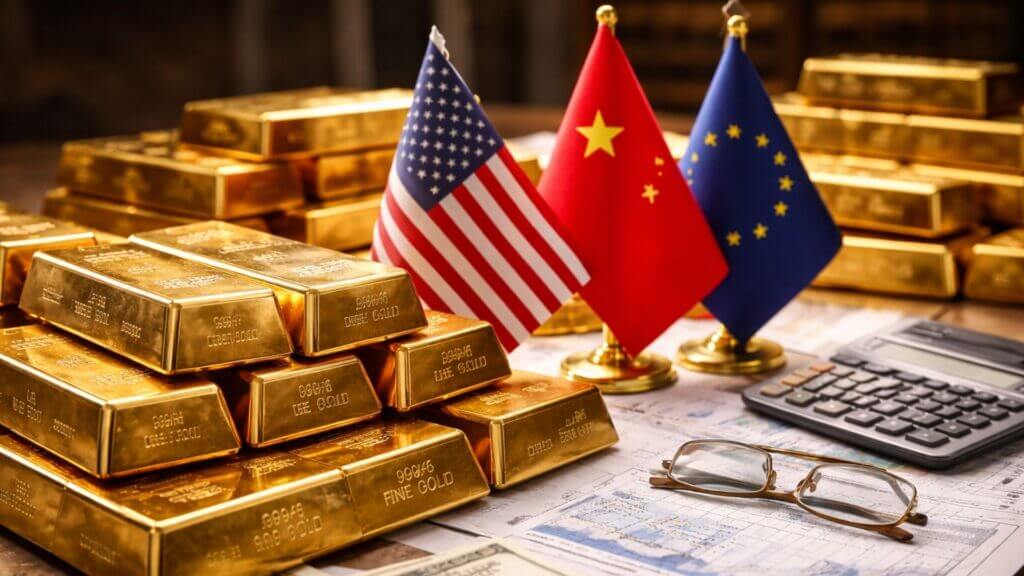
Image: Buying gold. What is a fair price? Many factors can affect the price of investment gold. Attention investors: the fair price of gold is primarily determined by the current economic and geopolitical environment.
How “Silence” Affects Prices and Markets
-
Delayed disclosure.
Many central banks do not report monthly purchases, so the WGC revises totals once IMF/WGC updates arrive—for example, the upward revision of 2024 demand to 1,086 tonnes announced in early 2025. -
London leasing and New York flows.
Logistical bottlenecks—large shipments to New York when COMEX premia rise—increase demand for gold leasing from holders (including central banks), temporarily tightening London liquidity.
PURCHASE OF GOLD. Free information. You can get up to 1/3 more precious metals!
- How can you buy gold and silver for investment?
- Much cheaper.
- We discover how you can reduce seller commissions.
- Highest quality. 999/1000. Good delivery.
Information worth its weight in gold. Completely free
It is not worth buying a single gram until you have this information.
Enter your name and email address now to participate for free.

What This Means for Companies, States, and Individuals
- For states: Gold is a “sovereignty reserve” in a world where foreign assets can be frozen overnight. In crises, it can support external financing or swaps.
- For businesses: Strong reserves bolster credit confidence and can lower crisis-era financing costs, indirectly supporting exporters.
- For savers: The signal is simple—institutions tasked with stability want assets independent of foreign politics or debt markets.
- For long-term projects: Gold doesn’t generate returns like equities, but it reduces tail risk and stabilizes financing for long-horizon investments.
What to Expect Next (2026–2027)
-
Persistent but non-linear buying.
WGC surveys show record appetite for further purchases, but monthly flows will remain volatile due to prices, logistics, and politics. -
More repatriations or reallocations.
India’s >100-tonne move home, and earlier programs in Austria, Germany, and the Netherlands, suggest a continued “part home, part London” model. -
Even more discretion.
Amid geopolitical tension and tariff/sanctions debates, communication will be quieter; some purchases will only be revealed with a lag.
Key Micro-Stories That Capture the Trend
- Poland: From ambition to execution—largest buyer in 2024; the ~20% gold target is now reality.
- China: Tactical pauses followed by renewed buying through 2026.
- India: More gold and more at home—gold’s share of reserves has doubled over four years; >100 tonnes repatriated in 2024.
- Venezuela: A legal reminder of location risk.
What Should the Average Reader Remember?
Gold is a national insurance policy—not for yield, but for independence and crisis liquidity.
After 2022, the concept of “safe reserves” changed: FX assets in foreign infrastructure can be frozen; gold in a domestic vault is much harder to lock away.
Quiet buying isn’t a theory—it’s an operational necessity for large players who don’t want to push prices against themselves and must respect disclosure rules.
FAQ
To hedge sanctions risk (frozen reserves), diversify away from the USD, manage inflation, and hold a sovereign asset without counterparty risk.
According to the WGC, Poland was the largest buyer (≈90 tonnes).
No. They predominantly buy physical gold via the London OTC market and store it at the BoE or in domestic vaults.
Liquidity and infrastructure (BoE custody, Good Delivery standard), plus fast swapping, lending, and settlement.
Yes – the Venezuela case at the BoE confirmed that political recognition can affect access.
The WGC 2026 survey shows a record share of central banks expecting to increase gold reserves.