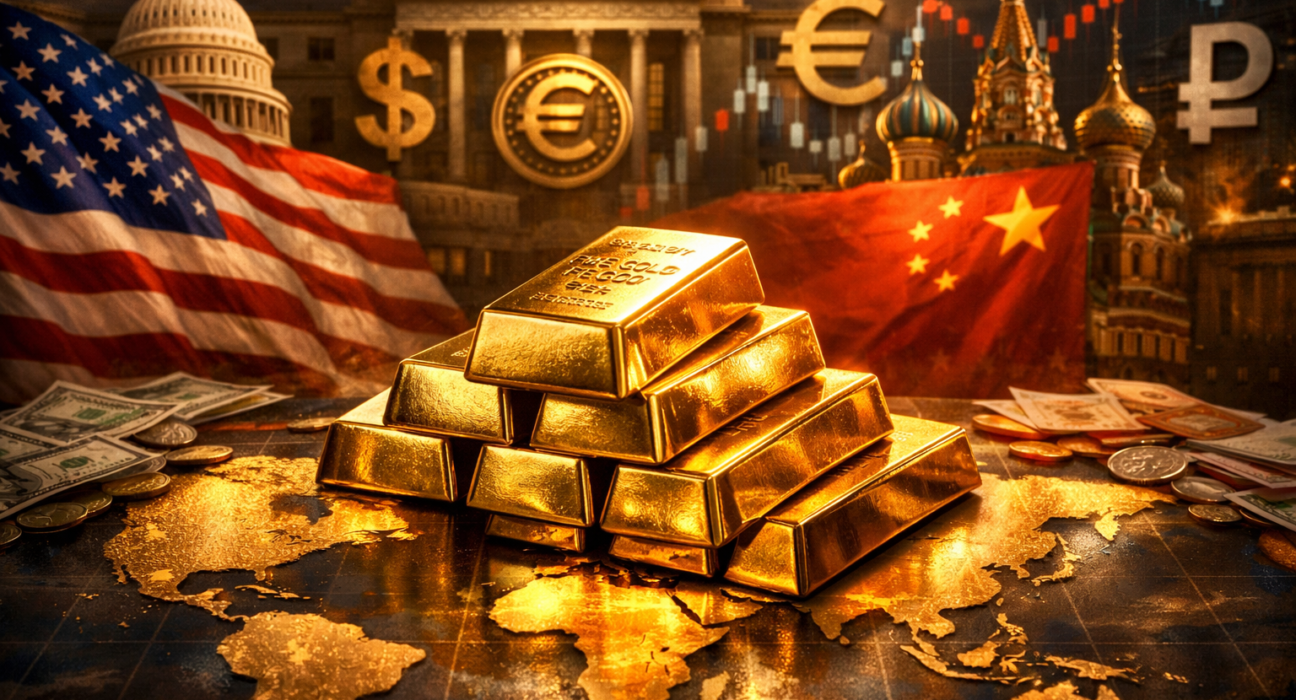
When gold prices briefly touched $3,500 per ounce in April 2026, many observers blamed an “irrational market.”
But the move was far from irrational.
Central banks were buying gold at record levels. Sanctions were reshaping trade flows. Countries were repatriating reserves. Payment systems were slowly splitting into “Eastern” and “Western” rails.
Gold — an asset with no counterparty risk — has quietly become a very real instrument of geopolitics.
1. Why Gold Has Become a Political Asset Again
Gold is not a bond, not a bank liability, and not a promise by any government.
It is a real asset that historically rises during periods when stocks and bonds decline in times of crisis.
Even the European Central Bank has highlighted that gold prices tend to increase during periods of heightened geopolitical uncertainty, precisely because of its role as a safe-haven asset.
2. Central Banks Are the Main Driver
Central banks have become the largest structural source of demand for gold.
- In 2022, central banks purchased around 1,136 tonnes of gold, the highest level in modern records.
- In 2023, purchases again exceeded 1,000 tonnes.
- By 2026, analysts expect the fourth consecutive year of roughly 1,000 tonnes of net purchases.
Why?
- Because governments increasingly want:
- diversification away from the U.S. dollar
- assets immune to sanctions
- reserves that carry no political counterparty risk


Do not buy a single gram of gold or silver until you have read this gold valuable information.
- Did you know that you can pay up to 59% more than the market price of gold?
- How can you significantly reduce the price of gold and silver?
- You can get up to + 1/3 more precious metals for your savings!
- Physical investment gold and silver of the highest quality. Good delivery.
BONUS! Extremely tax efficient: you pay absolutely no tax!
Enter your name and email address now to participate for free.

3. China: A Strategic Long-Term Buyer
The People’s Bank of China (PBOC) has emerged as one of the most active official gold buyers.
In 2023, it became the largest central bank buyer globally.
After a six-month pause in mid-2024, China resumed purchases in November 2024, continuing to increase reserves through 2025 and into 2026 with consecutive monthly additions.
- China’s strategy is clear:
- build strategic gold reserves
- develop alternative financial infrastructure
- reduce vulnerability to external financial pressure
4. Sanctions as a Boomerang: How Russian Gold Changed Direction
Sanctions reshaped global gold flows.
In March 2022, the London Bullion Market Association (LBMA) suspended Russian refiners from its Good Delivery list.
By June 2022, the United States, United Kingdom and G7 partners banned imports of newly mined Russian gold.
The London market effectively closed to Russian supply.
But gold did not disappear.
Instead, trade flows shifted toward new hubs, particularly Dubai and the United Arab Emirates, which became major channels for redirected Russian gold.c
- The geopolitical lesson is simple:
- Sanctions rarely stop commodity flows — they reroute them.
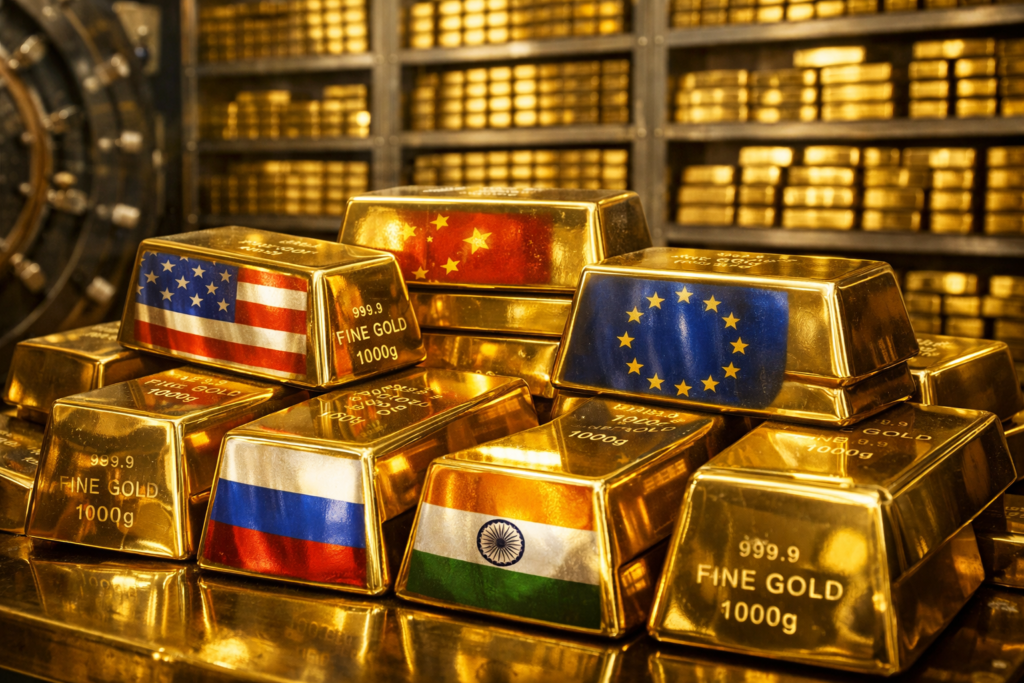
Image: Crises like COVID-19 often lead to market panic and monetary expansion, strengthening gold’s role as a hedge against inflation.
5. India: The Cultural Superpower of Gold
India remains the largest private holder of gold in the world.
Indian households are estimated to hold around 25,000 tonnes of gold.
At the same time, the Reserve Bank of India (RBI) has gradually increased official reserves.However, the period was relatively calm, with no dramatic performance gap between gold and bonds.
- The combination of:
- strong cultural demand
- steady central-bank accumulation
creates a powerful and stable gravitational pull in global gold markets.
6. Unexpected Players: Poland, Turkey and Singapore
Several countries have made remarkably large gold purchases in recent years.
- Poland
The National Bank of Poland purchased more than 100 tonnes of gold in 2023, explicitly describing gold as a guarantee of national sovereignty.
- Turkey
Turkey has alternated between selling gold to support domestic liquidity and rebuilding reserves, but it remains a major gold market participant.
- Singapore
The Monetary Authority of Singapore (MAS) significantly increased reserves in 2023, signaling that even global financial hubs are strengthening their gold positions.
7. Repatriation: “Gold Is Safer at Home”
In a world of geopolitical tension, the location of gold reserves matters almost as much as the quantity.
- Several countries have repatriated their gold:
- Germany (Bundesbank) moved hundreds of tonnes from New York and Paris back to Frankfurt.
- The Netherlands repatriated part of its reserves from the United States.
- Hungary first repatriated gold and later dramatically increased its holdings.
The message is clear:
sovereignty includes control over physical reserves.
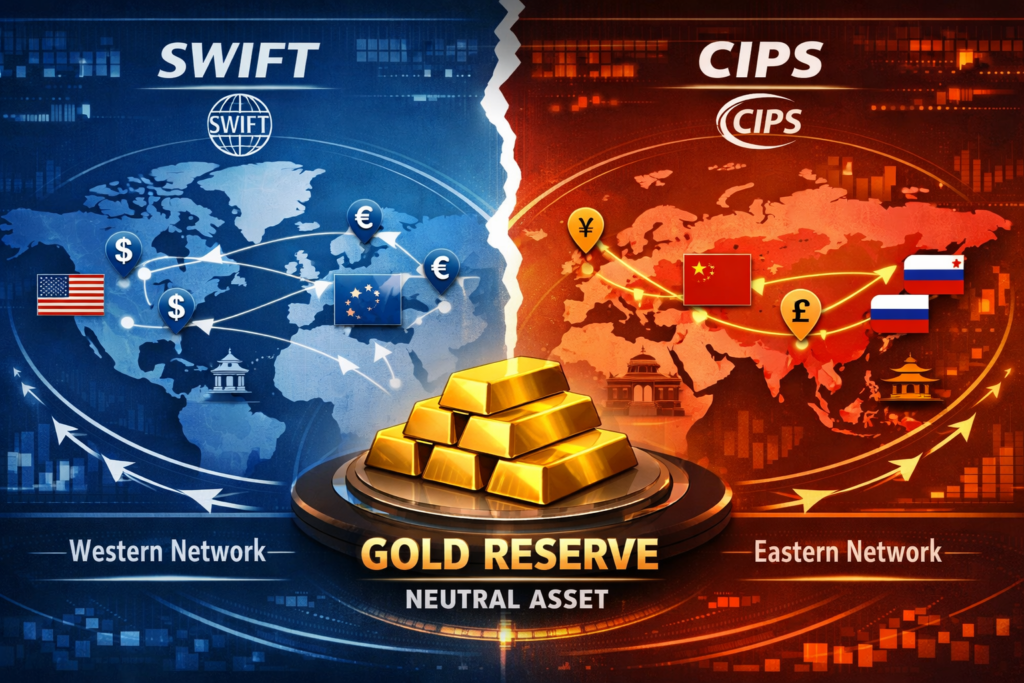
Image: Unlike paper money, physical gold provides tangible security and serves as a trusted hedge against inflation and economic uncertainty.
8. Parallel Payment Systems: CIPS and SPFS
The global financial system is slowly fragmenting.
After Western sanctions disconnected some banks from SWIFT, alternative systems gained importance.
China expanded CIPS (Cross-Border Interbank Payment System).
By 2024, CIPS processed RMB 175.5 trillion ($24.5 trillion) in cross-border payments — 43% growth year-over-year.
Russia operates SPFS, its own alternative system, although the U.S. Treasury warns foreign banks about secondary sanction risks when interacting with it.
This does not mean the end of the dollar, but it does signal infrastructure fragmentation.
9. Petrodollar vs Petro-Yuan
In 2022, Chinese President Xi Jinping publicly proposed expanding oil trade settlements in Chinese yuan via the Shanghai exchange.
However, analysts from S&P Global believe the shift away from the dollar in oil markets will likely remain slow and partial.
- Still, trends are emerging:
- China has increased imports of Russian oil
- some transactions occur outside the dollar system
These signals point to gradual monetary diversification.
10. The 2026 Gold Price Record
Gold surged past $3,500 per ounce in April 2026, setting a series of new records.
- Key drivers included:
- U.S.–China trade tensions
- monetary policy uncertainty
- strong central-bank demand
The World Gold Council identified a growing “risk premium” embedded in gold prices.
Market surveys during 2026 still expected gold to average above $3,000 per ounce for the year.
11. Sanctions as a Financial Weapon
After Russia’s invasion of Ukraine, Western countries froze roughly $300 billion of Russian foreign reserves, largely held via Euroclear in Europe.
Afghanistan’s reserves were also frozen after August 2021.
In this environment, gold becomes extremely valuable.
Physical gold stored in domestic vaults cannot be frozen with a financial transaction.
Surveys of central banks show that many expect to increase gold allocations over the next five years while reducing exposure to the dollar.
12. Has Gold Overtaken the Euro?
In 2026, several reports suggested that gold had surpassed the euro as the second-largest global reserve asset after the U.S. dollar.
- However, the European Central Bank mainly emphasizes:
- rising gold demand
- increasing reserve diversification
The exact ranking depends heavily on methodology and timing.
13. The Shadow Side: Illegal Gold Flows
Where demand rises, shadow markets often follow.
Reports indicate that hundreds of tonnes of gold leave Africa each year outside official statistics, often passing through the United Arab Emirates before entering global refining networks.
Gold geopolitics therefore also raises ethical and transparency questions.
PURCHASE OF GOLD. Free information. You can get up to 1/3 more precious metals!
- How can you buy gold and silver for investment?
- Much cheaper.
- We discover how you can reduce seller commissions.
- Highest quality. 999/1000. Good delivery.
Information worth its weight in gold. Completely free
It is not worth buying a single gram until you have this information.
Enter your name and email address now to participate for free.

14. What This Means for Companies, Governments and Investors
- Companies
Supply chains increasingly face currency risk and sanctions exposure. Some firms hold gold as a liquid strategic reserve.
- Governments
- Reserve strategy now involves three elements:
- quantity
- location
- speed of access
- Individuals
Institutional gold ETFs provide price exposure.
However, for true geopolitical resilience, some investors prefer physical gold stored outside the banking system.
(This is general information, not investment advice.)
15. Three Scenarios Toward 2030
- Scenario 1 – Accelerating Fragmentation
More sanctions and local payment systems appear.
Central banks continue buying gold.
Gold remains structurally strong but volatile.
- Scenario 2 – Soft Reset
Geopolitical tensions ease and trade stabilizes.
Gold prices cool, but central-bank demand provides a strong floor.Examples: 1970s, 2001–2011, 2024–2026
- Scenario 3 – Capital Controls
Major economies introduce tighter financial controls.
Physical gold becomes a crucial insurance asset.
16. Conclusion: Gold as the Neutral Notary of the Global System
-
Gold does not vote.
It does not sign treaties.
It does not negotiate trade agreements.
- And yet, precisely because of this neutrality, gold serves as a silent notary of the global financial system.
In a world increasingly shaped by sanctions, tariffs and competing financial infrastructures, gold remains an enduring anchor of trust.
Not because the world is returning to the past —
but because countries want a future with fewer vulnerabilities.
FAQ
Physical gold stored in domestic vaults is harder to sanction than foreign currency reserves held abroad. However, trade restrictions can redirect gold flows.
To diversify away from the dollar, reduce political risk and avoid the vulnerabilities exposed by frozen reserves.
Some analyses suggest this may be the case, but results depend on methodology and how reserves are measured.
No. The dollar remains dominant, but rising yuan settlements and systems like CIPS suggest gradual diversification.
A combination of geopolitical tensions, central-bank buying and global economic uncertainty.
An ETF provides exposure to gold prices, but it is not the same as owning physical gold stored directly under your control.
India, where households are estimated to hold around 25,000 tonnes of gold.
It refers to moving national gold reserves from foreign vaults back to domestic storage, as Germany, the Netherlands and Hungary have done.