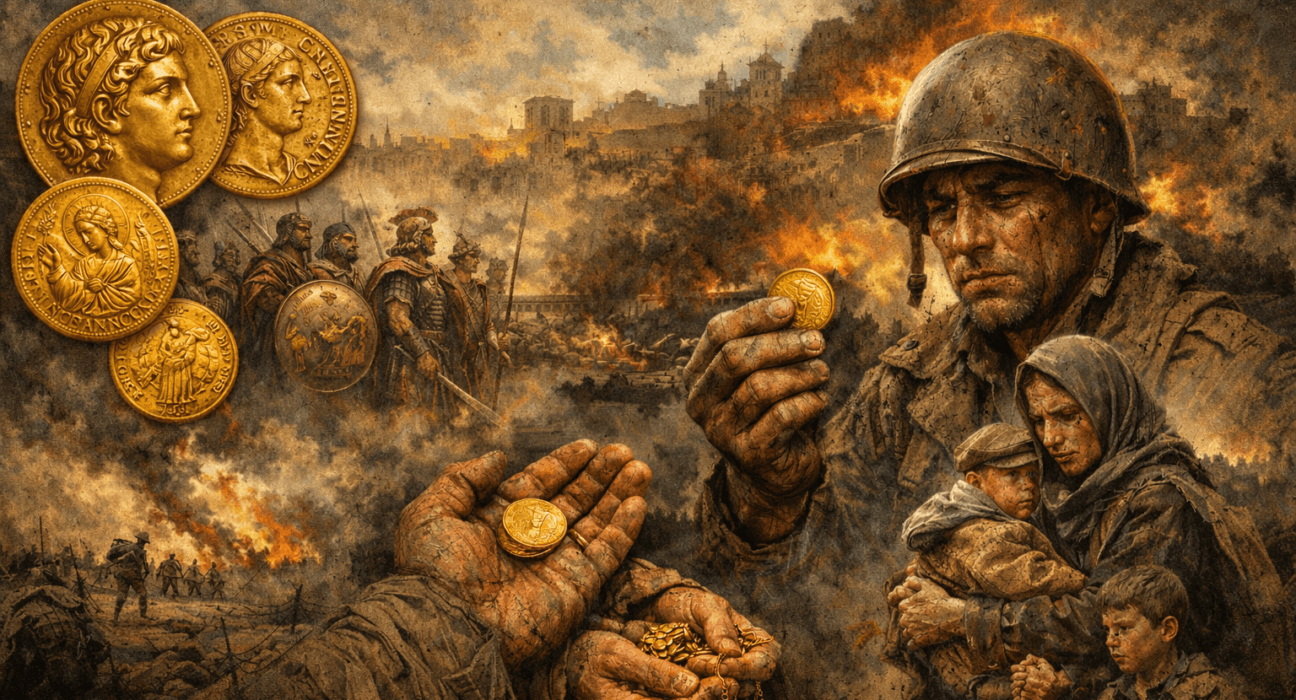
The Currency of Survival
In peaceful times, gold is often overlooked. Everyone talks about stocks, real estate, and cryptocurrencies. But when war, crisis, or inflation appears, the same pattern repeats again and again: paper money disappears, while gold remains.
Paper can be printed by governments. A bank account can be frozen overnight. Stock markets can be closed.
But a gold coin can be carried in your pocket across a border and used to buy food, shelter, or even freedom.
It is no coincidence that an old saying states:
“He who has gold makes the rules.”
Antiquity: Gold as a Weapon of Conquest
When Alexander the Great conquered the Persian capital Persepolis in 330 BC, chroniclers recorded that he discovered the largest treasure of the ancient world: thousands of tons of gold and silver that the Persian dynasty had accumulated over centuries.
With that gold, Alexander financed his campaign all the way to India. Soldiers’ wages, the construction of roads, and the founding of new cities were all funded with gold. Without this wealth, Alexander would never have become “the Great.”
A similar story occurred in Rome. A Roman legionary received a monthly payment in a gold aureus coin (about 8 grams of gold). When emperors began minting coins with less precious metal and diluting them with copper, their value fell, inflation exploded, and trust in the empire collapsed. Yet the aureus largely preserved its purchasing power.
Byzantium and the Middle Ages: Gold as the “Euro” of Its Time
The Byzantine solidus, a coin made from 4.5 g of gold, circulated for an astonishing 700 years. Merchants from China to England accepted it without hesitation.
If you had traveled from Constantinople to Venice in the 10th century, a single solidus could have paid for clothing, a horse, and a fine dinner.
Just as today, one ounce of gold could pay for a luxury suit and a hotel night.
During the Crusades, knights were paid in gold.
- 1 ounce of gold could buy a horse
- 3–5 ounces could buy a full suit of armor
Those who set out without gold often quickly became beggars—or never traveled very far.
The Napoleonic Wars: The Rothschilds and British Gold
Napoleon attempted to dominate Europe but underestimated Britain’s financial power.
Great Britain financed its wars through borrowing backed by the Rothschild banking family, always secured with gold.
While French soldiers fought on the Iberian Peninsula, the British commander Wellington paid his troops in gold coins.
While French finances were weakened by debt, British gold maintained trust and motivation among soldiers.
The American Civil War: Paper vs. Gold
Between 1861 and 1865, the United States was divided by civil war. Both sides began printing their own banknotes.
- The Confederacy issued “greyback” dollars, which lost almost all their value within a few years.
- The Union printed “greenback” dollars, which also steadily lost purchasing power.
On the New York Gold Exchange, one ounce of gold was officially worth $20.67.
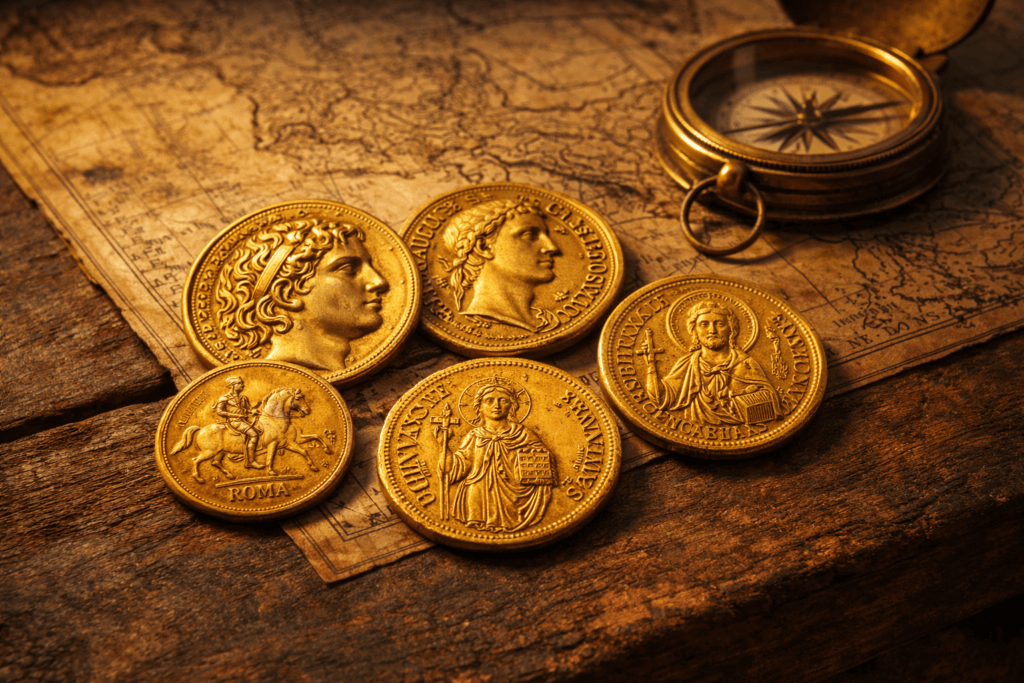
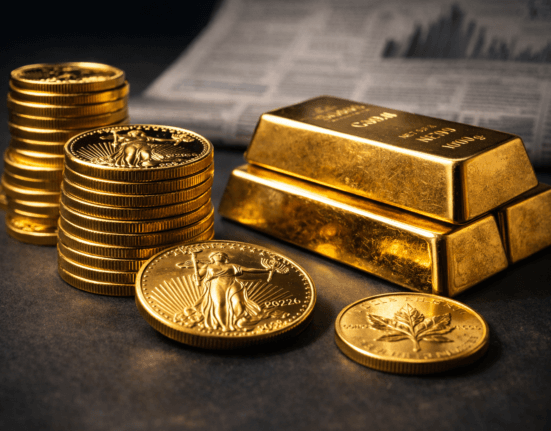
Image: Do you know where and how to buy gold? One of the most common options for buying gold is physical gold, such as coins, bars, or jewelry.
In paper dollars, however, the price rose to as much as $300 per ounce — clear proof of the collapse in paper currency value.
Merchants trusted only gold.
In practice, this meant:
- If you had a gold coin, you could buy food.
- If you had stacks of paper banknotes, you might receive nothing.
World War I: Gold in a Soldier’s Backpack
When World War I began in 1914, all major countries suspended the gold standard so they could print money for the war effort.
Inflation affected Germany, Britain, and France alike.
However, military commanders understood that paper money alone was not enough.
British soldiers often carried gold “Sovereign” coins in their backpacks.
These coins meant more than a soldier’s salary — they meant survival.
If captured, a soldier could use gold coins to:
- buy food
- bribe guards
- secure a way out of captivity
Gold became the currency of survival, even on the front lines.


Do not buy a single gram of gold or silver until you have read this gold valuable information.
- Did you know that you can pay up to 59% more than the market price of gold?
- How can you significantly reduce the price of gold and silver?
- You can get up to + 1/3 more precious metals for your savings!
- Physical investment gold and silver of the highest quality. Good delivery.
BONUS! Extremely tax efficient: you pay absolutely no tax!
Enter your name and email address now to participate for free.

World War II: Gold Saves Lives
During World War II, the role of gold became even more obvious.
- The Nazis systematically looted gold from central banks in occupied countries (Belgium, the Netherlands, Czechoslovakia).
- Gold was used to purchase strategic materials from neutral countries, such as Sweden (tungsten and iron).
- The Allies transported European gold reserves to the United States and Canada to prevent them from falling into German hands.
But the most powerful stories come from ordinary people.
Jewish families fleeing persecution carried a few gold coins or pieces of jewelry hidden in their clothing.
These small pieces of gold allowed them to:
- buy food on the black market
- obtain forged documents
- pay smugglers to cross borders
A testimony recorded in the book “Holocaust Testimonies” states:
“When we fled, we only had a few gold coins. Those coins bought bread and milk for our children. Without them, we would not have survived.”
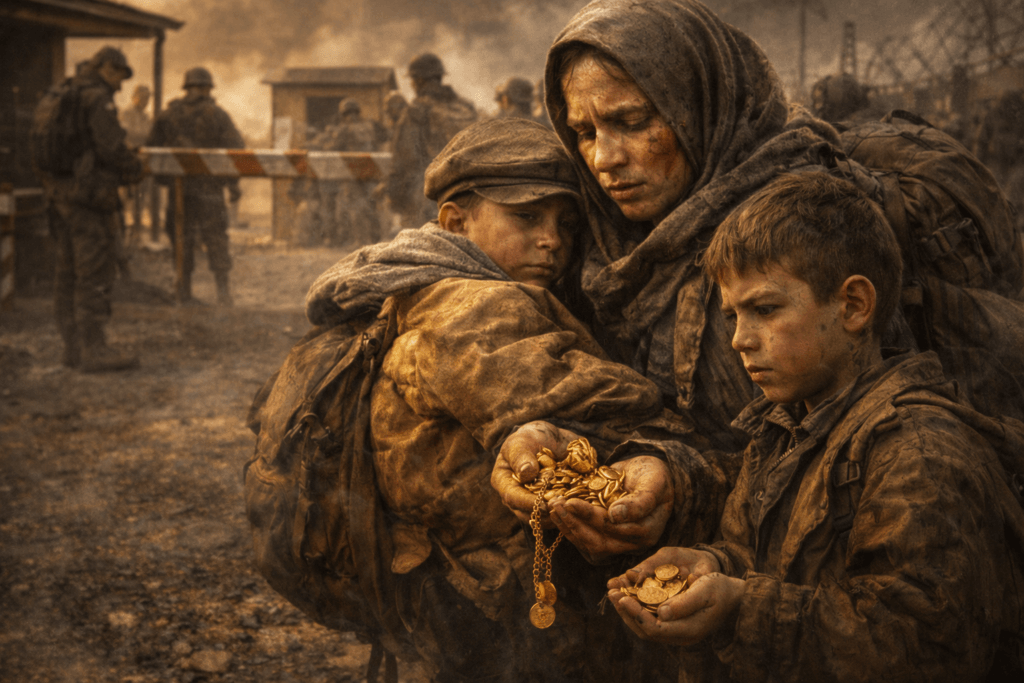
Image: Buying gold. What is a fair price? Many factors can affect the price of investment gold. Attention investors: the fair price of gold is primarily determined by the current economic and geopolitical environment.
The Cold War: Gold as a Strategic Reserve
After World War II, the Bretton Woods system was established, linking the US dollar to gold (35 USD per ounce).
The United States held the largest gold reserves in the world and became a financial superpower.
But in the 1960s, the US began printing too many dollars to finance:
- the Vietnam War
- domestic social programs
Other countries began demanding gold in exchange for their dollars.
In 1971, President Nixon closed the “gold window” and ended the gold standard.
From that point on, the dollar became a fiat currency without gold backing, while the value of gold began rising.
Meanwhile in Vietnam, gold coins became an escape currency. People used them to pay smugglers, pilots, and transporters who helped them flee Saigon.
Yugoslavia, Argentina, Ukraine: Modern Lessons
- Yugoslavia (1990s): Bags of Money for Bread
During the breakup of Yugoslavia, inflation spiraled out of control.
Newspapers reported that people carried bags full of banknotes just to buy a single loaf of bread. By the afternoon, that same loaf cost twice as much.
In Ljubljana and Belgrade, shopkeepers often said:
“Bring German marks or gold — we no longer accept dinars.”
Marija, now a retired woman from Maribor, remembers:
“My husband had a few gold rings in a drawer that he inherited from his mother. When there was no milk or bread left, I went to the market. For one ring, I received enough food for an entire month. Without gold, we would have gone hungry.”

- Argentina (2001 and 2019): Frozen Accounts
In December 2001, the Argentine government suddenly closed banks and froze all accounts.
Newspapers called the event “corralito” — a financial prison.
People stood in front of ATMs that would not even dispense $100.
For many families, gold became the only way out.
For many families, gold became the only way out.
- Those who had gold coins or jewelry could sell them to buy food and fuel.
- Those who did not were left empty-handed — even if they officially had $10,000 in the bank.
The same pattern returned in 2019. Banks limited withdrawals, inflation surged, and people again rushed into dollars and gold.
The newspaper La Nación reported:
“Black market gold trading has exploded. People are buying and selling gold because it is the only safe currency.”
PURCHASE OF GOLD. Free information. You can get up to 1/3 more precious metals!
- How can you buy gold and silver for investment?
- Much cheaper.
- We discover how you can reduce seller commissions.
- Highest quality. 999/1000. Good delivery.
Information worth its weight in gold. Completely free
It is not worth buying a single gram until you have this information.
Enter your name and email address now to participate for free.

- Ukraine (2022): Gold as a Passport
When war broke out in February 2022, millions of Ukrainians fled across borders.
- Bank cards stopped working
- Banks were closed
- Cash was often not accepted
Olena from Kharkiv shared her story with the Kyiv Independent:
“We had a few gold coins and some jewelry. When we arrived in Poland, we sold them and used the money to pay for an apartment and food. Without gold, we would have slept on the street.”
For many refugees, gold literally became a passport to survival.
The Psychological and Practical Perspective
Why does gold work during crises?
- It is small and portable.
- It is universally accepted.
- It does not depend on the internet, electricity, or banks.
For a family fleeing war, a gold coin can be worth more than thousands of euros in a bank account.
Gold — The Currency of Wars and Crises
Every crisis confirms the same truth:
Paper fails. Gold remains.
- Alexander conquered with gold.
- Rome collapsed when trust in its coins was destroyed.
- Jewish families survived the Holocaust thanks to gold coins.
- People in Yugoslavia bought a month of food with a gold ring.
- Ukrainian refugees in 2022 survived with gold jewelry.
👉 When war or crisis arrives, those who hold gold are better prepared to survive.
As the old saying goes:
“He who has gold makes the rules.”
✨ May Fortuna be with you — and may your gold be your passport through future crises.
FAQ
Because paper money and banks often lose value during wartime. Governments print money to finance military costs, which causes inflation. Banks may close, and people lose access to their savings. Gold remains accepted everywhere — for food, security, and survival.
When the dinar lost its value, people carried bags of cash to buy a single loaf of bread. Those who owned gold exchanged it on the black market for food and essential goods. One well-known story from Maribor describes a family buying a month’s worth of food with a single gold ring.
Gold was the only universal currency they could use to pay smugglers, obtain forged documents, or cross borders. Many testimonies describe how a few gold coins meant the difference between life and death.
During the 2001 crisis, banks froze accounts. People could not access their savings even if they had large balances. Those who owned gold sold it to buy food and fuel. The same pattern repeated in 2019 during another financial crisis.
Because it can be carried in a pocket and used anywhere in the world. In 2022, Ukrainian refugees carried gold coins and jewelry that allowed them to pay rent and buy food abroad. Bank cards did not work, banks were closed — but gold was always accepted.