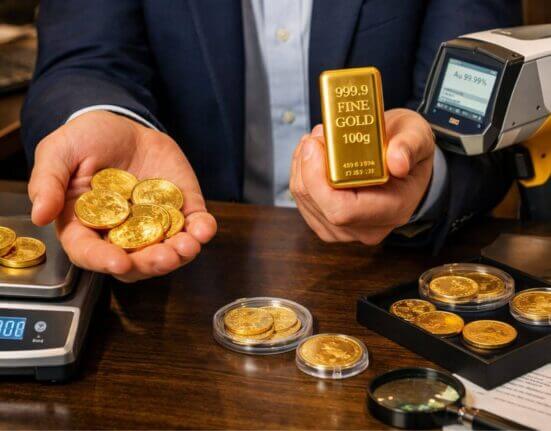
Buying gold sounds simple: you check the “spot price,” choose a coin or a bar, and pay.
In reality, your final price is the result of several factors: the spot price in USD, the EUR/USD exchange rate, the product premium, payment and delivery costs, and — if you purchase remotely — EU withdrawal rules, which often do not apply to investment gold because its price depends on financial market movements.
Below is a comprehensive, practical guide written for everyday buyers in 2026, based on real EU regulations and verified procedures, so you can complete your first gold purchase confidently, clearly, and safely.
Define Your Goal: Why Gold for You?
First, answer honestly:
Are you buying gold for safety (store of value, peace of mind), liquidity (quick conversion to cash), diversification (typically 10–15% of total assets), or as a tactical hedge (small “crisis reserve”)?
- If safety is your priority: focus on standard 1 oz coins and 50–100 g bars.
- If you want smaller emergency units: 1/10 oz coins are often more practical than 1 g bars (lower hidden cost per gram in real terms).
- If investing a larger amount (e.g., €20,000–€50,000): consider combining 1 oz coins (liquidity) with 50–100 g bars (lower €/g cost).
Choose Recognizable Products: Gold Standard Is Your Best Friend
Popular 1 oz bullion coins include Krugerrand, Maple Leaf, Philharmonic, American Eagle, Britannia, and Kangaroo.
Common bar sizes are 10 g, 20 g, 50 g, and 100 g — ideally in sealed assay packaging and produced by refineries listed on the London Bullion Market Association (LBMA) Good Delivery List.
Why does this matter?
Recognized products typically have tighter buy-back spreads, more global buyers, and standardized verification procedures. Non-standard forms (grains, powder, “unique” shapes) often resell only at melt value and may involve additional costs.
Understand the Difference Gold Between Spot Price and Your Final Price
Your retail price is calculated as:
Spot (USD/oz) → Converted into EUR → + Product premium → + Payment/delivery/insurance costs.
Important points:
- Spot price is a wholesale reference.
- You are buying a manufactured product with production, minting, and logistics costs.
In periods of market stress (as seen during past volatility spikes), retail premiums can rise significantly due to supply constraints and increased demand. During such times, comparing your purchase price directly to the “bare” spot number on your phone can be misleading.
Illustrative example (2026 scenario):
Spot: €3,120 / oz
1 oz coin with +6% premium = €3,307
100 g bar with +5% premium = €10,500 (≈ €3,266 per oz equivalent)
1/10 oz coin with +12% premium = €341 (≈ €3,752 per oz equivalent)
Conclusion: Smaller units are psychologically easier to buy but financially more expensive per gram. A balanced combination often makes sense.

Image: Do you know where and how to buy gold? One of the most common options for buying gold is physical gold, such as coins, bars, or jewelry.
Remote Purchases: Does the 14-Day Withdrawal Right Apply?
In the EU, online purchases generally include a 14-day withdrawal right. However, Directive 2011/83/EU explicitly provides an exception when the price depends on financial market fluctuations beyond the trader’s control and that may occur during the withdrawal period.
Investment gold typically falls under this exception. As a result, many reputable dealers do not offer a withdrawal right for bullion products.
Always check the dealer’s terms and conditions carefully.
EU Rules You Must Know in 2026
- VAT
The supply of investment gold in the EU is exempt from VAT under Directive 2006/112/EC. The EU publishes an annual list of gold coins that qualify under the investment gold definition.
- Crossing External EU Borders
Under Regulation (EU) 2018/1672, if you carry €10,000 or more in “cash” when crossing an external EU border, you must declare it.
“Cash” includes:
- Gold coins with a purity of at least 90%
- Gold bars or nuggets with a purity of at least 99.5%
This requirement applies at external EU borders. Within internal EU borders, this declaration rule does not apply, although national AML procedures may still be relevant.


Do not buy a single gram of gold or silver until you have read this gold valuable information.
- Did you know that you can pay up to 59% more than the market price of gold?
- How can you significantly reduce the price of gold and silver?
- You can get up to + 1/3 more precious metals for your savings!
- Physical investment gold and silver of the highest quality. Good delivery.
BONUS! Extremely tax efficient: you pay absolutely no tax!
Enter your name and email address now to participate for free.

- AML / KYC
Under EU anti-money laundering directives (2015/849, amended by 2018/843), dealers must conduct customer due diligence for certain transactions, especially higher-value or cash transactions. Identity verification is standard practice and should not be seen as unusual.
Note: Taxation of capital gains for private individuals depends on national law and may change. Always consult a tax advisor before selling.
How to Choose a Dealer: 10 Essential Questions
- 1. What is the premium (percentage above spot) for this exact product in EUR?
- 2. Is your buy-back formula (spot − X%) publicly stated?
- 3. Is the product in stock or pre-order? What is the delivery timeline?
- 4. If you offer storage: is it allocated or unallocated? Is it insured? What are exit fees?
- 5. How do you test authenticity upon buy-back (weight, dimensions, XRF, ultrasound, conductivity)?
- 6. Does the bar originate from an LBMA-accredited refinery?
- 7. What payment methods are available, and are there fees?
- 8. Who bears the delivery risk until receipt? Is the shipment insured?
- 9. Do you hold relevant licenses or industry memberships?
- 10. What are your withdrawal terms under Article 16 of Directive 2011/83/EU?
Red flags include:
- No transparent pricing or buy-back formula
- Aggressive promotion of “special numismatic editions” with 20–80% premiums
- Vague storage explanations
- Pressure tactics such as “last pieces available” without written delivery guarantees

Image: Buying gold. What is a fair price? Many factors can affect the price of investment gold. Attention investors: the fair price of gold is primarily determined by the current economic and geopolitical environment.
Payment, Delivery and Insurance
SEPA bank transfer is usually the most cost-effective option. Card payments often include additional percentage fees.
Many courier services restrict or prohibit the transport of precious metals. Large dealers typically use specialized insured logistics providers or offer personal pickup at a vault.
Before paying, confirm in writing:
- Who bears the risk until you receive the product?
- What insurance coverage applies?
Pickup and Verification: Your 5-Point Ritual
- 1. Check weight using a digital scale.
- 2. Measure dimensions with a caliper.
- 3. Visually verify serial numbers (for bars) against invoice and assay certificate.
- 4. Perform a magnet test (gold is not ferromagnetic; note that tungsten is also not magnetic).
- 5. Request XRF and, for larger purchases, ultrasound or conductivity testing in your presence.
If a bar is sealed in assay packaging, do not open it unless necessary. Damaged packaging can reduce resale value.
Storage: Combine Home Tactics and Vault Strategy
- Vault Storage (Allocated)
The safest solution for core holdings. Ensure:
- Proper allocation
- Insurance coverage
- Transparent withdrawal or delivery fees
- Home Storage
Keep only a small portion at home (for example, a few 1 oz coins). Avoid the emotional assumption that “everything near me is safest.” Statistics on burglary and forced entry do not favor large home holdings.
If traveling across an external EU border with more than €10,000 in “cash” (including qualifying gold), declaration is required.

When to Buy: DCA vs. Trying to Time the Bottom
Dollar-Cost Averaging (DCA) means spreading purchases over 6–12 months. This reduces the risk of buying everything at a temporary price peak.
Trying to “buy the bottom” is psychologically appealing but often ineffective.
Gold is insurance, not a lottery ticket.
Three Educational Mini Stories
A retired couple was convinced to buy high-premium proof coins instead of standard bullion. They paid 30–60% above spot, and when selling, dealers offered only melt value.
Another buyer purchased an attractively priced 1 kg bar of unknown origin. Upon resale, additional testing and lack of documented chain of custody resulted in a lower offer.
A business owner requested XRF and ultrasound testing at pickup of 1 oz coins from a reputable dealer. The documented results provided peace of mind and future resale proof.
Lesson: Choose standard products, demand transparency, and test upon delivery.
Checklist: From Idea to Securely Stored Gold
- 1. Define your objective (safety, liquidity, diversification).
- 2. Select standard products (1 oz coins, 10–100 g bars, LBMA refineries).
- 3. Compare premiums and buy-back formulas from at least 2–3 dealers at the same time.
- 4. Review withdrawal terms under Article 16 of Directive 2011/83/EU.
- 5. Confirm payment method and insured delivery details.
- 6. Perform the 5-point verification test upon receipt.
- 7. Store invoices, serial numbers, and photos securely (cloud + offline copy).
- 8. Use vault storage for core holdings; keep only a small portion at home.
- 9. Declare qualifying gold if crossing an external EU border above €10,000.
- 10. Use DCA and avoid emotional timing decisions.
PURCHASE OF GOLD. Free information. You can get up to 1/3 more precious metals!
- How can you buy gold and silver for investment?
- Much cheaper.
- We discover how you can reduce seller commissions.
- Highest quality. 999/1000. Good delivery.
Information worth its weight in gold. Completely free
It is not worth buying a single gram until you have this information.
Enter your name and email address now to participate for free.

Conclusion
Your first gold purchase should feel boring — and that is a compliment.
Choose standard products.
Work with transparent dealers.
Understand EU VAT and withdrawal rules.
Test upon delivery.
Store securely.
When you understand the real rules, buying gold becomes a structured process — not a gamble.
FAQ
Yes. Investment gold is VAT-exempt under Directive 2006/112/EC, provided it meets the defined criteria.
Usually not. Directive 2011/83/EU provides an exception for goods tied to financial market fluctuations, which typically includes investment gold.
Many couriers restrict or prohibit precious metals shipments. Use insured specialist logistics or personal pickup.
When crossing an external EU border with €10,000 or more in qualifying “cash,” including certain gold coins and bars, you must declare it.
Check whether the refinery appears on the LBMA Good Delivery List. This is the industry standard for wholesale acceptability and a strong indicator of trust in retail markets.