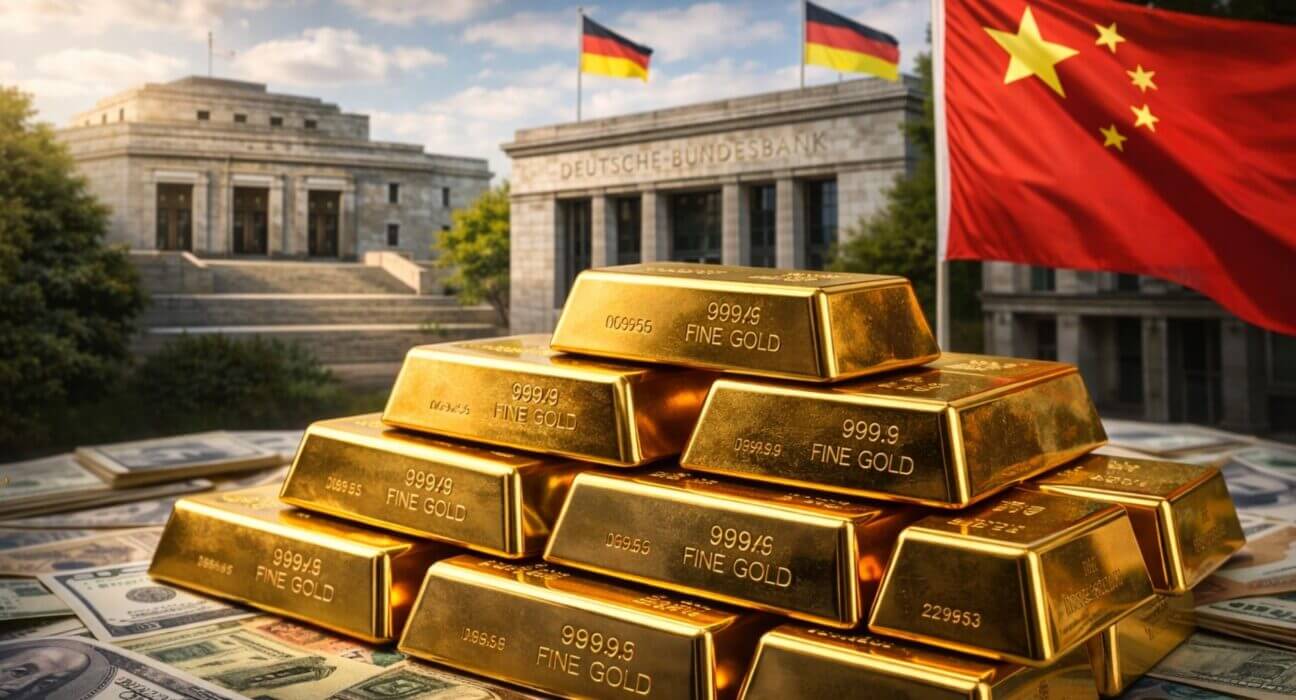
If you were to walk beneath New York’s financial district one morning, you would be standing above a hidden “city” of roughly 507,000 gold bars. This is not a movie set, but the vault of the Federal Reserve Bank of New York (FRBNY)—the largest known repository of monetary gold in the world. It stores gold for dozens of countries and international institutions. Notably, it does not store the gold of the U.S. government itself. That gold lies elsewhere, behind different doors and under different rules.
In this report-style article, we open the three largest “wardrobes” of modern gold reserves – the United States, Germany, and China – and add several key players (the IMF, Italy, and France). We go beyond headline numbers to show where the gold is, how it is secured, why transparency has become a new currency of trust in the 21st century, and why China prefers to communicate through action rather than words.
United States: Three Fortresses and a Century of Myths
U.S. official gold (legally owned by the U.S. Treasury) is distributed across three main locations: Fort Knox (Kentucky), West Point (New York), and Denver (Colorado), plus a smaller working stock. According to the U.S. Mint (updated in early 2023), the total amounts to roughly 248 million troy ounces (~7,700 tonnes), broken down as follows:
- Fort Knox: ~147.34 million oz (~4,583 t)
- West Point: ~54.07 million oz (~1,681 t)
- Denver: ~43.85 million oz (~1,364 t)
- Working stock: ~2.78 million oz
This distribution aligns closely with the widely cited total U.S. reserve figure of ~8,133 tonnes, regularly reported by the World Gold Council.
Fort Knox has long been a magnet for speculation. In 1974, the U.S. Mint allowed journalists and members of Congress inside—specifically to counter persistent rumors that “less gold was there than claimed.” Another high-profile visit came in August 2017, when then–Treasury Secretary Steven Mnuchin toured Fort Knox and jokingly tweeted: “The gold is safe.” Not an audit—but a symbolic reassurance that the gold is physical and present.
The crucial distinction: U.S. sovereign gold is not held at the New York Fed. The FRBNY vault—home to thousands of tonnes and roughly 507,000 bars—primarily holds gold for foreign central banks and international institutions. The underground vault on Liberty Street is therefore a crossroads of geopolitical trust: countries store gold there for liquidity and access to the London–New York OTC market, not because the U.S. is “holding its own gold.”

Image: Do you know where and how to buy gold? One of the most common options for buying gold is physical gold, such as coins, bars, or jewelry.
Germany: From “Gold in Exile” to Home Shelves — A Transparency Playbook
After World War II, Germany’s Bundesbank stored much of its gold in New York, London, and Paris. In 2013, Berlin made a historic decision: by 2020, half of Germany’s gold should be back in Frankfurt.
The result was a logistical success story. 300 tonnes were repatriated from New York and 374 tonnes from Paris—completed ahead of schedule, with the project formally finished in 2017.
More important than the physical move was trust. In 2015, the Bundesbank published a complete bar list of all its gold—thousands of pages detailing serial numbers, fine weight, and purity. This was unprecedented. The list is regularly updated and set a new standard: don’t just say what you have—show it.
Why keep gold both at home and abroad? Domestic storage provides sovereignty and political security, while London and New York provide liquidity. With “loco London” and FRBNY custody, Germany can pledge, swap, or lend bars in interbank transactions without physically moving them across continents.
China: Quiet Accumulation and Fragmented Signals
Since late 2022, the People’s Bank of China (PBOC) has frequently reported monthly increases in gold reserves. After a brief pause in mid-2024, buying resumed in November 2024 and continued through 2026, marking consecutive monthly additions.
The official PBOC figure for mid-2026 stands at roughly 74 million troy ounces—about 2,300 tonnes. Between the lines, however, lies a broader picture: import flows via Hong Kong, Shanghai, Switzerland, and the UAE point to sustained underlying demand beyond official disclosures.
Hong Kong data previously showed triple-digit percentage jumps in net gold imports during periods of strong Chinese demand, driven by diversification and persistent domestic price premiums. Meanwhile, global investment demand surged sharply year-on-year, reinforcing the picture of gold’s renewed strategic role.
The “open secret” is this: Beijing rarely reveals the full picture in real time. In the language of global traders, the rule is simple—watch flows, not statements. China’s gold strategy reflects diversification away from the USD, sanctions hedging, and confidence-building in its domestic financial system.
IMF, Italy, France: The “Fourth Corner” of the Square
Including institutions, the IMF would rank third globally, with about 2,814 tonnes (90.5 million oz) of gold held across designated depositories. This gold originated from member quotas and historical transactions and remains a structural reserve layer of the international system.
Italy and France are among the largest sovereign holders, with roughly 2,452 tonnes and 2,436 tonnes, respectively. The Banca d’Italia is notably transparent, clearly explaining why it holds gold (insurance, crisis liquidity, sovereign reserves), where it is stored, and how it is audited.
About half of Italy’s gold is held domestically in Rome (Palazzo Koch), with the rest stored in New York, plus smaller amounts at the Bank of England and the Swiss National Bank—a practical blend of sovereignty and global liquidity.


Do not buy a single gram of gold or silver until you have read this gold valuable information.
- Did you know that you can pay up to 59% more than the market price of gold?
- How can you significantly reduce the price of gold and silver?
- You can get up to + 1/3 more precious metals for your savings!
- Physical investment gold and silver of the highest quality. Good delivery.
BONUS! Extremely tax efficient: you pay absolutely no tax!
Enter your name and email address now to participate for free.

Why Location Matters: London, New York, Rome
- London (Bank of England):
The world’s largest OTC gold hub. The BoE publishes monthly custody totals (with a short lag), a rare and welcome transparency feature. LBMA data suggest roughly 400,000 bars across London vaults—mostly for foreign central banks, not the UK Treasury.
- New York (FRBNY):
The largest known depository of monetary gold, holding foreign official reserves under well-documented custody practices.
- Rome (Banca d’Italia):
A model showing that domestic storage can coexist with seamless access to global markets.
When “Silence” Becomes Strategy: Central Banks, 2022–2026
Since 2022, central banks have bought gold at scale: record levels in 2022 and 2023, 1,086 tonnes in 2024 (WGC revision), and expectations of around 1,000 tonnes again in 2026. The drivers are clear: sanctions risk, dedollarization, and the desire for unencumbered insurance assets.
In early 2025, London even experienced a logistical bottleneck after large shipments to the U.S. (COMEX premia), leading to increased gold lending demand from central banks and temporary delays at the BoE—a vivid example of how physical logistics and financial incentives directly affect market liquidity.
Repatriation and Legal Lessons: Germany, the Netherlands, India—and Venezuela
- Germany: Completed repatriation early (2017); half of reserves now in Frankfurt.
- Netherlands: Returned 122.5 tonnes from New York in 2014.
- India: Moved over 100 tonnes from the UK to domestic vaults in 2024, reinforcing sovereignty.
- Venezuela: A sobering legal case - 31 tonnes held at the BoE became inaccessible for years due to disputes over political recognition. Lesson: even gold held abroad has legal filters.

“Who Holds the Most?” -And Why Rankings Aren’t Enough
By WGC and IMF data, the top tier includes: the U.S., Germany, the IMF, Italy, France, followed by China (~2,300 t by 2026), Russia, Switzerland, Japan, and India. But tonnage alone is only step one. Location, transparency, and operational usability matter just as much.
Germany shows how transparency builds public trust. China shows how steady, quiet accumulation – backed by import flows – can be equally powerful for markets.
Image: Buying gold. What is a fair price? Many factors can affect the price of investment gold. Attention investors: the fair price of gold is primarily determined by the current economic and geopolitical environment.
Why Gold Is “Back” - As Seen from the Vaults
By 2026, gold prices had reached new highs, driven less by classic inflation hedging and more by geopolitical premiums and central-bank demand. Translated into vault terms: more countries want more gold, closer to home—while still maintaining bridges to London and New York for hour-level liquidity.
PURCHASE OF GOLD. Free information. You can get up to 1/3 more precious metals!
- How can you buy gold and silver for investment?
- Much cheaper.
- We discover how you can reduce seller commissions.
- Highest quality. 999/1000. Good delivery.
Information worth its weight in gold. Completely free
It is not worth buying a single gram until you have this information.
Enter your name and email address now to participate for free.

Key Takeaways (for Businesses, States, Savers)
- Businesses: Reserve strength and legal clarity affect crisis-era capital costs and trade financing risk.
- States: The modern “gold standard” is domestic security + London/New York liquidity.
- Savers: When institutions responsible for stability increase gold exposure, it signals gold’s role in uncertainty.
Final Thought
State gold is not a museum artifact—it is trust infrastructure. U.S. gold is spread across three fortresses; German gold is a lesson in transparency; Chinese gold is a quiet indicator of shifting gravity. All paths converge in a handful of underground rooms—London and New York—where bars are not just metal, but keys to liquidity, diplomacy, and calm when the world becomes unpredictable.
FAQ
U.S. sovereign gold is stored in three main depositories: Fort Knox, West Point, and Denver. Fort Knox holds approximately 147.34 million troy ounces (~4,583 tonnes). In total, U.S. Mint vaults hold about 248 million troy ounces (as of early 2023).
No. The Federal Reserve Bank of New York (FRBNY) stores foreign official reserves (for central banks and international institutions). The vault itself is the largest known depository of monetary gold in the world.
Between 2013 and 2017, the Deutsche Bundesbank repatriated 300 tonnes from New York and 374 tonnes from Paris to Frankfurt, completing the project ahead of schedule. It also published a full bar list of all gold bars.
The People’s Bank of China (PBOC) reported 73.96 million troy ounces (≈2,300 tonnes) as of July 2026, marking the ninth consecutive month of increases. At the same time, net gold imports via Hong Kong jumped sharply.
The International Monetary Fund (IMF) holds about 2,814 tonnes (90.5 million oz) of gold across multiple designated depositories, historically accumulated through member quotas and transactions.
Because of liquidity (London/New York), sovereignty (domestic storage), and legal risk—as illustrated by Venezuela’s gold held at the Bank of England, where access depended on political recognition.